Prompt0 5.36.
2026
Virtual Photography
In-game photographic archive, AI selection and sequencing, synthetic studio photographs of virtual objects
Variable dimensions / installation version
The viewer arrives too late: the image has already been seen.
In the video game Final Fantasy XV (2016), the player controls Noctis, who travels with three companions controlled by the game. One of them is Prompto, a non-player character (NPC). He carries a camera and takes photographs on his own, without player input. The game decides when he takes a photograph, how he frames it and which filter it uses. The image only appears later, after the moment has passed.
Over more than 200 hours and two full playthroughs, I collected 3,224 photographs. The second playthrough tested Prompto’s photographic behaviour: which scenes the game makes him photograph again, where it repeats a composition and where a new image appears. What began as an automatic photo album became an archive through which the rules of the in-game camera could be traced.
Within the story, this photography is an act of friendship. Prompto preserves the life of the group and gives it back to his companions as a shared album. Over time, his archive also became my visual memory of the journey. I lived the journey; the game produced the images through which it stayed with me.
I gave the archive to two models to test what kind of past they would construct from images alone. The first assigned an aesthetic score to each of the 3,224 photographs and reduced the archive to around 300 images. The second examined them one by one, selected 36 and built a five-act sequence. I set only the number: 36, the number of exposures on a standard roll of 35mm film. The second model determined the selection, order and structure. It produced a convincing account of the journey while knowing nothing about the time, attachment, frustration and accidents behind the photographs. Some of its choices, however, unexpectedly aligned with my memory.
My memory held on to details the selection had barely registered. Prompto sometimes took close-ups of Gladio’s ass; I later returned to the game and photographed those trousers myself, answering his image and continuing a gesture begun by the program. I hate fishing in games. In Final Fantasy XV, I forced myself through the entire questline because I wanted to reach the coveted scripted photograph Prompto takes after the final catch. The last fish took hours. When I finally caught it, the game gathered the characters for the mandatory group photograph. The sun blew out part of the image, but the photograph was still tender: after all that slog, they were finally standing together. The photograph preserved the moment; the lure held everything that led to it—frustration, stubbornness, dozens of attempts and the anticipation of the image.
Those details became the basis of a second archive. I returned to the game and photographed virtual objects and creatures through which I remembered the journey. These are the only source photographs in the project for which I chose both the subject and the moment of capture. For the eighteen studio works, I used only the photographs from the 36-image sequence that connected with my own memories, pairing each with an object or creature associated with that part of the journey. Those pairings became material for generative systems. I had to wrestle each object out of the model through prompts, variants and corrections until the photograph and the object’s form locked into place. The road became a suitcase, the fishing scene became a lure, and portraits appeared on clothing, optical devices, vehicles and their components.
The result was a set of synthetic studio photographs of virtual objects. They look like studio photographs of tangible objects, although no physical originals exist. To me, they are souvenirs from a journey that leaves no physical objects to bring home. Once the objects were made, I returned the full archive to the work so that the 36-image sequence would not stand in for the entire journey. Across the eighteen final works, every one of the 3,224 photographs appears once, from first to last, in its original chronological order.
The boundary between adjacent works falls approximately halfway between the last source image linked to one object and the first source image linked to the next. One work may therefore contain several dozen frames, while another contains several hundred. The span of archive contained in each work records the chronological distance between those points. Each synthetic object enters the sequence at the position of its source photograph: that frame triggers the object, which expands around it and occupies neighbouring cells in the archive grid. If the source photograph falls within the object’s outline, the image continues across its surface. White areas mark the cells in the archive grid occupied by the synthetic studio image.
Most archive photographs are shown at 80 per cent opacity. The 36 images selected by the model and the additional source photographs remain fully visible. Selection becomes part of the work’s surface: the full archive remains present alongside the frames to which the model assigned greater weight. I designed a protocol that keeps those decisions visible within the final form. Prompto’s camera had already chosen the moments of capture; the models later imposed weight and order on the archive. By returning all 3,224 photographs and fixing the structure, I made that chain legible. Authorship is delegated across it, while responsibility for its structure remains mine. The model-generated narrative and my memory never fully align. They meet in some places and diverge in others. That partial overlap produces a distributed vision.
The final cycle leaves this chain exposed within a single structure. The 36-image edit remains coherent, but now sits inside the larger archive it was cut from. All 3,224 photographs retain the pressure of decisions made before and after the shutter was triggered. The past takes shape under that pressure before it can settle into personal memory.
The archive is complete, but the journey remains larger than any version made from it.
Prompt0 5.36. — Complete eighteen-part cycle.
Together, the eighteen works reproduce Prompto’s complete archive of 3,224 photographs once, from first to last, in chronological order.
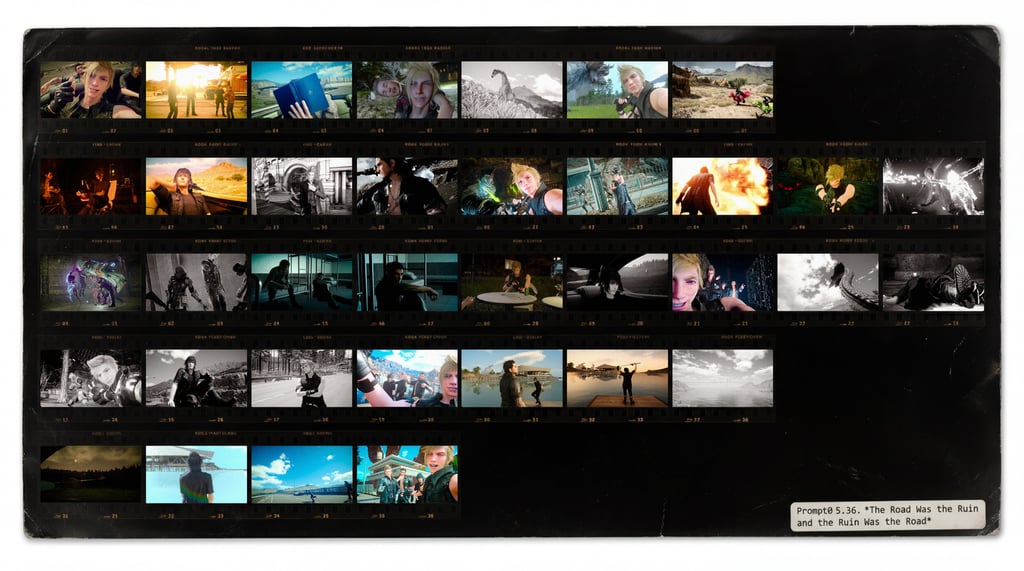
The Road Was the Ruin and the Ruin Was the Road
Contact sheet of 36 photographs. An AI model selected images from Prompto’s archive and arranged them into a five-act sequence.
The title emerged from a subsequent AI-generated textual reading of that sequence.


